Head loss due to Transitions and Fittings (Local loss)
Whenever flow velocity changes direction or magnitude in a conduit (e.g., at fittings, bends, and other appurtenances) added turbulence is induced. The energy associated with that turbulence is eventually dissipated into heat that produces a minor head loss, or local (or form) loss. The local (minor) loss associated with a particular fitting can be evaluated by

where V = mean velocity in the conduit (m/s, ft/s)
K = loss coefficient for the particular fitting involved.
The table given below provides the loss coefficients (K) for various transitions and fittings.
Table 3-3: Typical Minor Loss Coefficients
| Type of form loss | K | ||
| Expansion | Sudden | D1 < D2 | 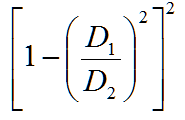
|
| Gradual | D1/D2 = 0.8 | 0.03 | |
| D1/D2 = 0.5 | 0.08 | ||
| D1/D2 = 0.2 | 0.13 | ||
| Contraction | Sudden | D1 > D2 | 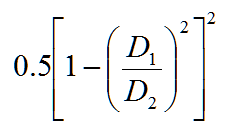
|
| Gradual | D2/D1 = 0.8 | 0.05 | |
| D2/D1 = 0.5 | 0.065 | ||
| D2/D1 = 0.2 | 0.08 | ||
| Pipe entrance | Square-edge | 0.5 | |
| Rounded | 0.25 | ||
| Projecting | 0.8 | ||
| Pipe exit | Submerged pipe to still water | 1.0 | |
| Tee | Flow through run | 0.6 | |
| Flow through side outlet | 1.8 | ||
| Orifice | (Pipe diameter
/orifice diameter) |
D/d = 4 | 4.8 |
| D/d = 2 | 1.0 | ||
| D/d = 1.33 | 0.24 | ||
| Venturi (long-tube) | (Pipe diameter
/throat diameter) |
D/d = 3 | 1.1 |
| D/d = 2 | 0.5 | ||
| D/d = 1.33 | 0.2 | ||
| Bend | 90o miter bend with vanes | 0.2 | |
| 90o miter bend without vanes | 1.1 | ||
| 45o miter bend | 0.2 | ||
| Type of form loss (continued) | K | ||
| Bend | 45o smooth bend:
(bend radius /pipe diameter) |
r/D = 1 | 0.37 |
| r/D = 2 | 0.22 | ||
| r/D = 4 | 0.2 | ||
| 90o smooth bend | r/D = 1 | 0.5 | |
| r/D = 2 | 0.3 | ||
| r/D = 4 | 0.25 | ||
| Closed return bend | 2.2 | ||
| Sluice | Submerged port in wall | 0.8 | |
| As conduit contraction | 0.5 | ||
| Without top submergence | 0.2 | ||
| Valve | Globe valve, fully open | 10 | |
| Angel valve, fully open | 5.0 | ||
| Swing check valve, fully open | 2.5 | ||
| Gate valve, fully open | 0.2 | ||
| Gate valve, half open | 5.6 | ||
| Butterfly valve, fully open | 1.2 | ||
| Ball valve, fully open | 0.1 | ||
Source: Nicklow and Boulos (2005)